
How To Become A Successful Artist?
October 16, 2026
I was up in Aspen last month for the second annual Aspen Design Conference where I had an exhibition at the Aspen Collective Gallery. The project I made is called Little Star, and it's currently on view at the gallery through October. It can also be seen on my site here.
The Aspen Design Conference is still in its infancy, but I love being part of it. I hope it continues to grow and attract more creative people to the Roaring Fork Valley to be inspired, talk about art and design and new ideas, and make new friends. I also got to play a listening event one evening in the gallery, which was really fun.
At the conference kickoff party, Kate and I were walking around the Aspen Mountain Artist Residency on the back side of Aspen Mountain. We were wandering around the property, looking at the old cabins and admiring the fall colors, when I bumped into a guy and started talking with him. He asked what I did, and I told him I was an artist and had made the work hanging in the Aspen Collective Gallery. His eyes got big. "That was you? I love that work. It's so good!" I thanked him. It's always nice to get a compliment, although I was a little skeptical at first. Then he pulled out his phone and showed me photos he'd taken of my work earlier that day.
I asked him what he did, and it turned out he was an economist by training who teaches at Yale. His name is Magnus Resch, and lives in New York and has spent much of his career studying the economics of the art market. What determines the value of art? How do galleries make money? How do artists make money? Which artists make money? How does an artist get a show at a gallery or museum? What happens when work is bought and resold on the secondary market?
In 2018, Magnus coauthored a study published in Science called Quantifying Reputation and Success in Art. The researchers looked at the exhibition histories of nearly half a million artists to understand what determines success in the art world. The abstract begins with this observation:
In areas of human activity where performance is difficult to quantify in an objective fashion, reputation and networks of influence play a key role in determining access to resources and rewards.
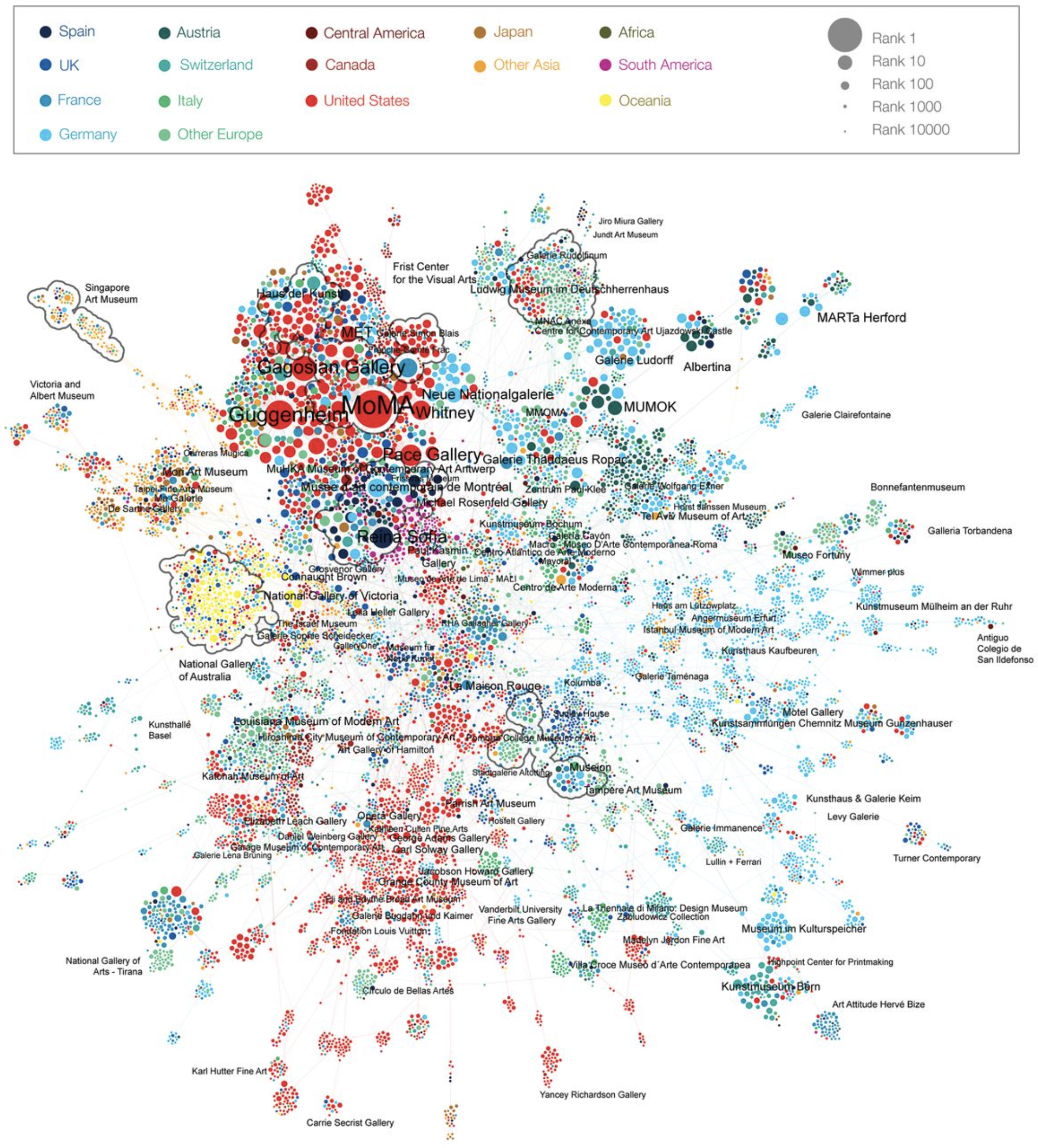
In other words, when it's difficult to objectively determine what's good, the people you know and the institutions that support you can have an enormous influence on your success. He later wrote a book called How to Become a Successful Artist, which explores many of these same ideas. We started chatting, and after complimenting my work a few more times, he said, "There's no reason why you shouldn't be selling half a million dollars of art every year."
I didn't really know what to say. I don't currently sell half a million dollars of art a year. But that would certainly be nice! He told me again that my work was really good and that I should have no problem selling it. Then he said something that stuck with me: I was like a soccer player who knows how to score goals but isn't taking any shots. That was a little hard to hear, but it was both a criticism and a compliment, which I can certainly appreciate.
Eventually we went our separate ways. About twenty minutes later, I looked across the party and saw Magnus talking to Kate. I walked over to join them, and they said, “…oh, we were just talking about you." Kate explained that Magnus had told her how much he liked my work, how he thought I should be selling half a million dollars of it every year, and how even after complementing me several times, I’d never even bothered to ask for his contact information.
My first reaction was to get defensive. I knew Magnus was someone who might be able to help me, but we also had three days of the conference ahead of us. We were both speakers at the conference, and I knew we'd cross paths many times over the next few days. But my approach to these things tends to be more organic. I like to let most things unfold naturally, and I've never been comfortable being pushy or aggressive or salesy. That said, there are opportunities that are asking to be seized, and it hadn't occurred to me to do that.
The following evening, at a conference dinner, I saw Magnus again and asked if he'd be willing to have lunch or coffee so I could learn more about his ideas and how they might apply to my work. He said yes, of course. The next day, after a walking tour of the Aspen Institute, we headed to a cafe around the corner from the gallery.
Over lunch, Magnus explained to me what he tells a lot of working artists. Artistic success has surprisingly little to do with the work itself. There are lots of artists making good work. What separates the financially successful ones is often their ability to share that work, build relationships, and develop a network of collectors, galleries, museums, and other people who can help advance their careers.
His research also suggests that the art world is remarkably concentrated. A relatively small number of galleries, museums, and collectors have an enormous influence on which artists become successful and which works become valuable. Artists who don't gain access to those institutions relatively early in their careers face long odds of reaching the very top of the market.
Of course, becoming part of art history isn't really my goal. My goal is to keep thinking about and making art. Thinking about art is easy. But to keep making art, you've got to sell art.
Magnus explained that, as an older white male artist who hasn't shown in top-tier galleries or museums, and who didn't get an MFA from Yale, my only real path forward is to cultivate my own network. His advice was to organize small, focused, intentional art events, carefully consider who to invite, and continue building relationships with those people. He also encouraged me to use Instagram to share the work and develop that community.
The prospect of this is a little daunting, partly because I live in a small town with a limited number of buyers, and partly because I don't love Instagram. I look at it, of course, but whenever I try to post something, it turns into a time suck. Minutes and hours disappear into staring at that little screen. So while I think there's a lot of truth in what Magnus told me, I'm not entirely sure what to do with it.
I also think there are lots of ways to define success as an artist. For some people, success is simply finishing the work. Selling it might not even be part of the equation. For me, I've always loved not just thinking about and making work, but sharing it. I also love installing works in their new homes.
Later that afternoon, Magnus was scheduled to speak on the main stage with Lucy McRae, an artist whose work spans sculpture, film, performance, science, and speculative design. Their talk was called Making Money as an Artist. Lucy has built a career working with museums, galleries, and commercial clients, which made her an interesting counterpoint to Magnus's research about how artists make a living.
One of the slides Magnus showed illustrated his argument about where value comes from in the art world. He put two photographs on the screen. Both showed a cowboy riding a horse through a landscape. They looked almost identical, with some subtle differences in color, and he asked the audience to guess which one was worth more.
One was originally photographed for a Marlboro advertising campaign, worth around $15,000. The other was an image appropriated by Richard Prince, a famous contemporary artist whose work has been shown in major galleries and museums. Prince had essentially rephotographed an existing advertisement, but the resulting artwork was worth around $4 million. I couldn’t find the exact image he used in his talk, but this is the same idea: on the left is the original (by Sam Abell) and on the right is the Richard Prince.
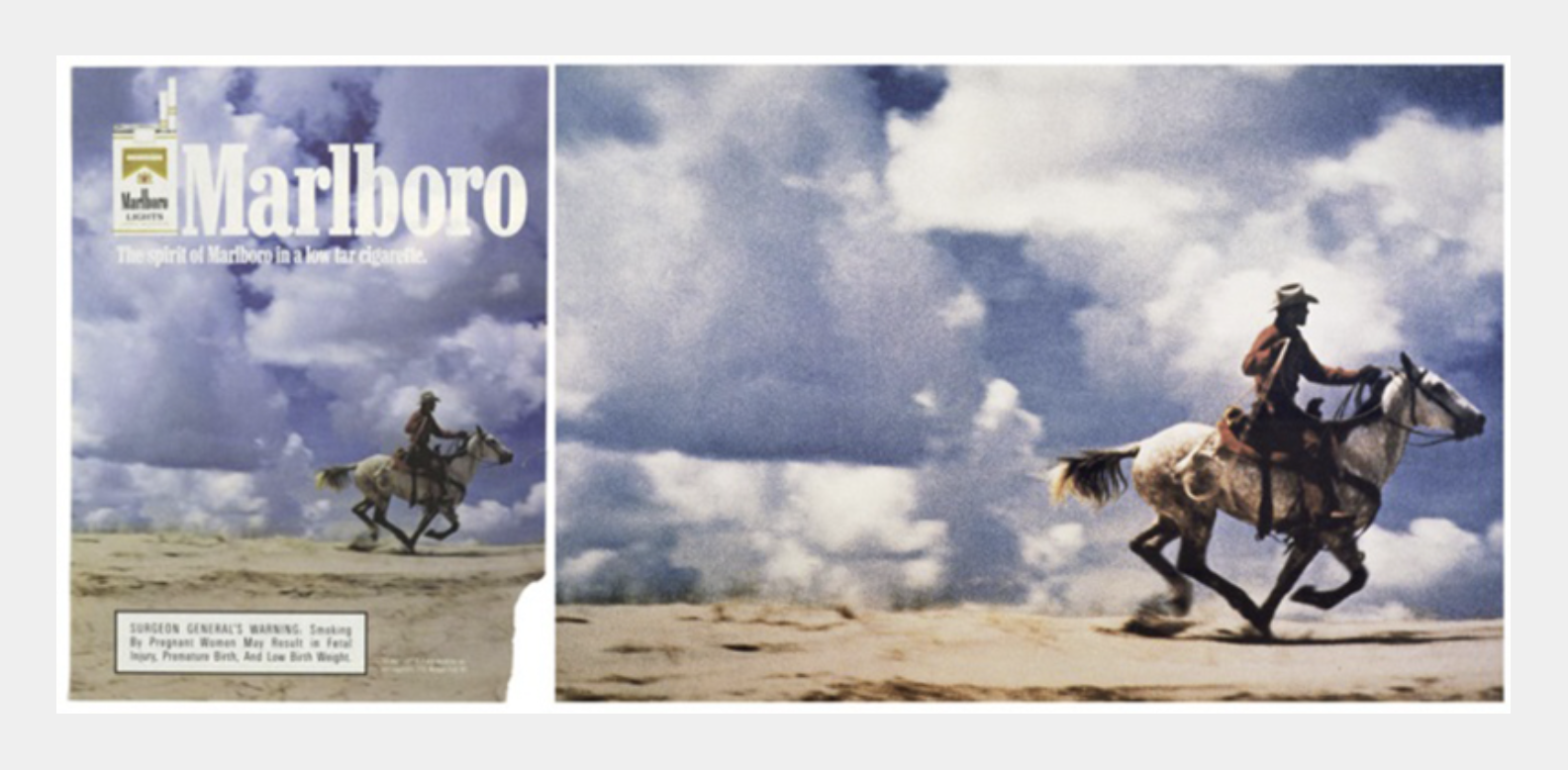
The point was that the difference in value wasn't necessarily in the image itself. It was in the context surrounding it. Who made it, who represented it, who collected it, where it had been exhibited, and how the art world had come to recognize its importance.
At another point during his talk, Magnus made the argument that there are lots of artists making good work, and he used mine as an example. He said something along the lines of, "There's an artist here in the audience, Jamie Kripke. His work is amazing. It should be in the MoMA. You can go downstairs and look at it. I recommend you all go see it today."
Thinking back to our first conversation, Magnus had already told me that my work was good and that there was no reason I shouldn't be selling more of it. Now, according to him, the main thing standing in my way was me.
His suggestion was for me to flip from 90% making and 10% selling to 10% making and 90% selling, adding “Don’t make any more work right now, you have enough work!”
After lunch, I realized that what he'd given me was actually a gift. His perspective is based on research, economics, and an understanding of how the art world works. It doesn't necessarily align with the way I think about making art, but that doesn't mean I shouldn't listen.
I’m not sure I want to turn my art practice into a business development exercise, and I don't want to spend my days cultivating Instagram followers. But meeting Magnus reminded me of something important. There is value in putting yourself out there, talking to people you might not normally talk to, asking questions, following up, and occasionally asking for something.
I still believe in letting things unfold naturally. But maybe I need to take a few more shots.